
Official Distributor


Authorized partner for premium quality products
Blocked DPF Causes Turbo Failure: Symptoms & Prevention Guide
18/02/2026
Blocked DPF Causes Turbo Failure
Symptoms, Testing & Prevention Guide
By Tomasz Kozien, DOMAT Automotive Engineering
There are many articles and technical documents relating to how a faulty turbo can lead to DPF damage. However, the DPF is actually responsible for more turbo-related failures than you might think. Here we explore what effect a blocked DPF can have on a turbocharger.
DPFs (Diesel Particulate Filters) were first introduced in January 2005 with the Euro 4 emission standard, where diesel particulate levels were reduced to extremely low levels to reduce the allowable amount of particulate matter (PM) released into the atmosphere. Reducing the size of PM from the combustion process to this level was not technically possible, so this meant all diesel vehicles after September 2009 were fitted with a filter to capture soot and other harmful particles, preventing them entering the atmosphere. A DPF can remove around 85% of the particulates from the exhaust gas.
A blocked DPF will not work correctly. To clear this blockage there are two types of regeneration which are commonly used to remove the build-up of soot. Newer vehicles engage active regeneration, which is the process of removing the accumulated soot from the filter by adding fuel post combustion to increase exhaust gas temperatures and burn off the soot, providing a temporary solution. Passive regeneration takes place automatically on motorway-type runs when the exhaust temperature is high. Many manufacturers have moved to using active regeneration as many motorists do not often drive prolonged distances at motorway speeds to clear the DPF. Constant short distances are not good for the turbo or exhaust system.
Fix the DPF Before You Fit a New Turbo
If a blocked DPF caused the original turbo failure and it isn't cleared or replaced first, a brand-new turbocharger will be exposed to the exact same back pressure and exhaust temperature that destroyed the last one. Fitting the replacement before addressing the DPF is one of the most common reasons a "new" turbo fails again within weeks or months.
Driver-Facing Symptoms of a Blocked DPF
Before any turbo damage becomes obvious, these are usually the first signs something's wrong upstream:
- DPF warning light on the dashboard
- Engine management light, sometimes flashing
- Noticeable loss of power or the vehicle entering limp mode
- Rough idle or unusually high fuel consumption
- Regeneration cycles that repeatedly fail to complete, or a strong smell during regeneration
- Black or excessive exhaust smoke
- Whistling or unusual turbo noise as back pressure builds
So, what happens to the turbo when a DPF is blocked?
A blocked DPF prevents exhaust gas passing through the exhaust system at the required rate. As a result, back pressure and exhaust gas temperatures increase within the turbine housing. Increased exhaust gas temperature and back pressure can affect the turbocharger in a number of ways, including:
- Problems with efficiencies
- Oil leaks
- Carbonisation of oil within the turbo
- Exhaust gas leaks from the turbo
How Back Pressure Is Actually Tested
Guessing from symptoms alone isn't reliable enough to confirm a DPF-related turbo failure — back pressure needs to be measured directly:
- Exhaust back-pressure gauge — a pressure gauge is connected to a port before the DPF (often via the oxygen sensor or a dedicated test point) and readings are taken at idle and under load, then compared against the manufacturer's specification
- Differential pressure sensor data — most vehicles already have a DPF differential pressure sensor; live diagnostic data from this sensor shows the pressure drop across the filter, which rises as the DPF blocks
- Boost pressure comparison — actual boost readings are checked against expected values for the engine; boost that's noticeably below spec, alongside high back pressure, points to restriction rather than a turbo fault
- Visual DPF inspection — where possible, the filter itself is inspected or its ash/soot loading value checked via diagnostics to confirm blockage rather than relying on pressure readings alone
How to spot a turbocharger that has suffered from DPF problems:
Discolouration of parts within the core assembly (CHRA)
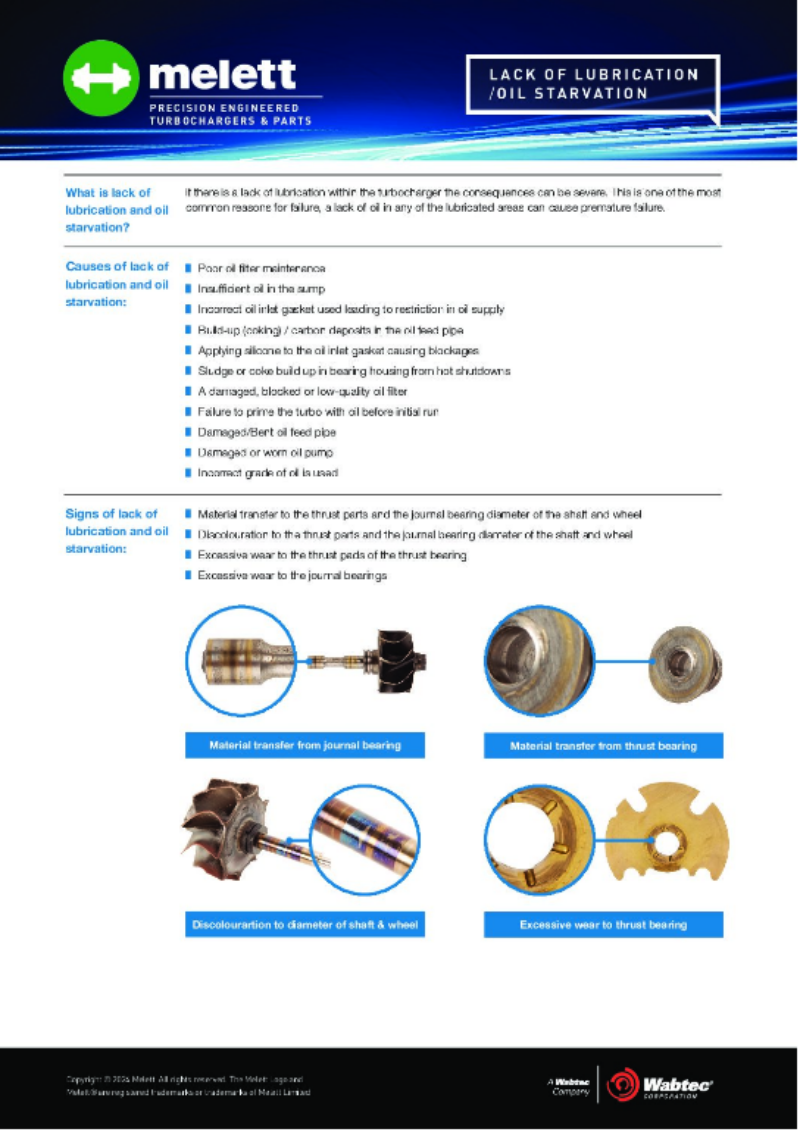
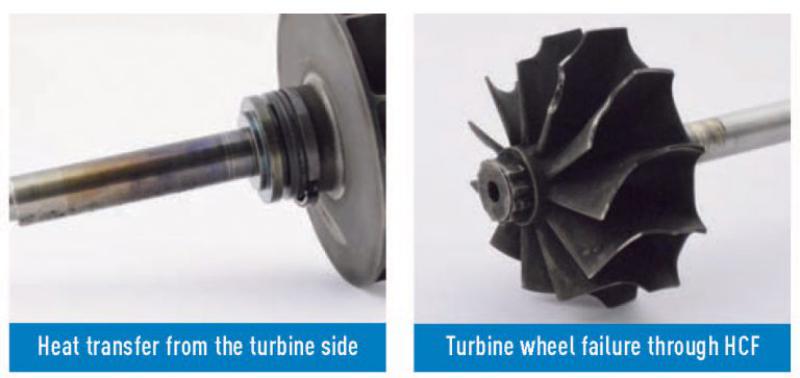
Usually with evidence that the heat is transferring through the CHRA from the turbine side. This excessive temperature within the CHRA is caused by back pressure forcing the exhaust gas through the piston ring seals and into the CHRA. The high temperature exhaust gas can prevent efficient oil cooling within the CHRA and even carbonise the oil, restricting oil feeds and causing wear to the bearing systems. This type of failure can often be mistaken as a lack of lubrication or contaminated oil.
Carbon build-up in the turbine side piston ring groove
Caused by the increased exhaust gas temperatures.
Oil leaks into the compressor housing
Can be seen as a consequence of exhaust gas forcing its way into the CHRA from the turbine side and forcing oil through the oil seal on the compressor side.
Exhaust gas forced through smallest gaps
A blocked DPF can force exhaust gas through the smallest of gaps, including the clearances in the bearing housing VNT lever arm and turbine housing waste gate mechanisms. If this occurs, carbon build-up in these mechanisms can restrict movement of the levers, affecting performance of the turbo. In some cases soot build-up can be seen on the back face of the seal plate where the exhaust gas has been forced through.
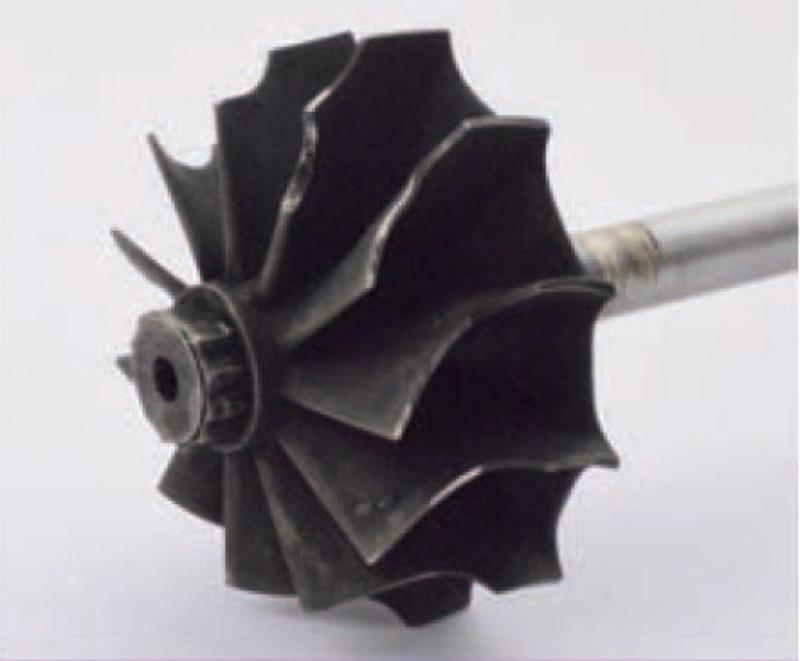
Turbine wheel failure
Caused by high cycle fatigue (HCF) due to temperature increase.
How can you prevent these failures from occurring?
As a starting point, it is essential to identify the failure mode and determine whether a DPF-related issue is the root cause. If the entire rotor assembly is okay, and there are some signs of overheating towards the turbine side of the core assembly, then the failure is likely to be caused by excessive exhaust gas temperatures. High amounts of carbon build-up within the VNT mechanism and lever arms indicate a blocked DPF, and the driver may experience turbo lag or over boost of the turbo.
To help prevent turbo failure caused by DPFs:
- Test for and confirm whether the DPF is actually blocked, using back-pressure and differential pressure data as above — don't assume from symptoms alone
- Contact a DPF specialist for advice
- Replace the DPF with a high quality replacement — lower cost DPFs will often not operate as efficiently as the original, which can replicate the environment of a blocked DPF
- Only once the DPF issue is resolved, replace the turbocharger core assembly to prevent possible oil leaks
- Check the actuator achieves its full range of movement, particularly if electronic, as internal components could be worn
Important: It takes time for a DPF to block, sometimes years. Once blocked though, turbo failure can occur very quickly. If you don't check for a DPF issue when installing a replacement turbo, there is a very high chance the replacement turbo will suffer the same failure, as it will be subject to the same operating environment as the previous unit.
Replacing a turbo damaged by a blocked DPF?
Get in Touch – We're Here to Help
Have questions? Our experts are ready to assist you!
